KI Praxis ToolsKiPT Voice
For physicians who want to listen during the consultationListen.Don’t type.
You listen, KiPT Voice writes. By the time the patient leaves the room the draft is already there — structured, in your words, ready for review. Even when an examination, a pause and a phone call come in between. The recording stays on your practice computer.
- Audio stays local
- Pause & resume
- Windows 11 · Mac with Apple chip
Developed with an internal medicine practice in Germany. Now available to every practice with long consultations.
The stack that is still waiting at the end of the day.
The last patient has left and an afternoon of documentation is still waiting — written from memory, because during the consultation you had no free hand. That is the stack KiPT Voice takes off you, even when an appointment is broken up by an examination, getting dressed, a look at the lab results and a phone call.
- Pause and resume as often as the appointment demands — what you end up with is one session and one draft.
- Microphone disconnected? The segment so far is safe, and recording continues afterwards.
- Computer crashed? That costs one segment, never the appointment.
- What you get at the end has the structure of the conversation, not three lines.
Three steps. Your workflow stays as it is.
Consent, then record
Create a session, confirm consent, record. Pause as often as the appointment requires.
Stop, and KiPT Voice takes it from there
The application transcribes the whole recording, attributes the speakers and writes the draft from your template.
Review, adopt, move on
Read the draft, correct it, copy it and paste it into your practice software. Finishing deletes the audio files.
This is what it really looks like
The application as it runs today: during recording and during physician review.
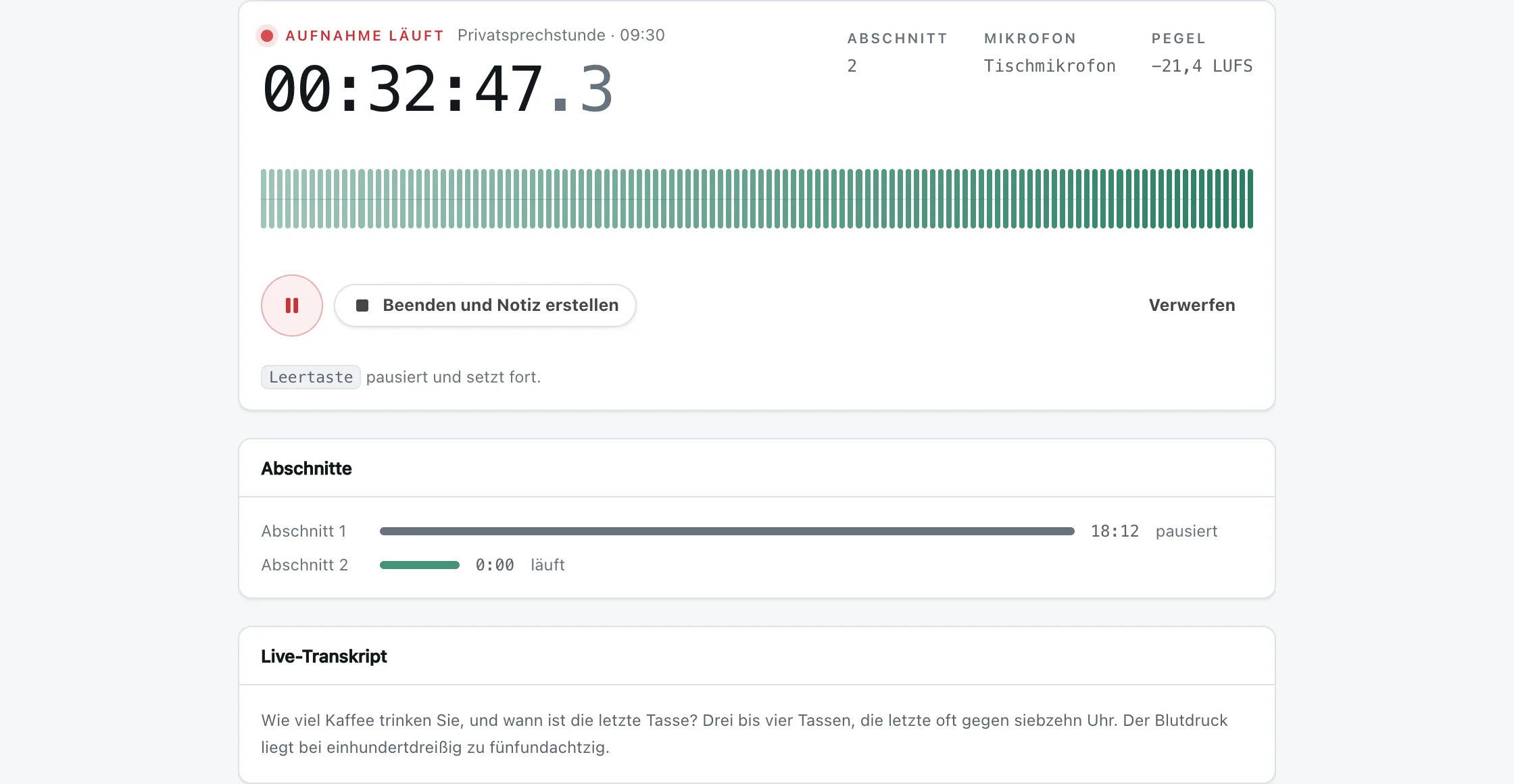

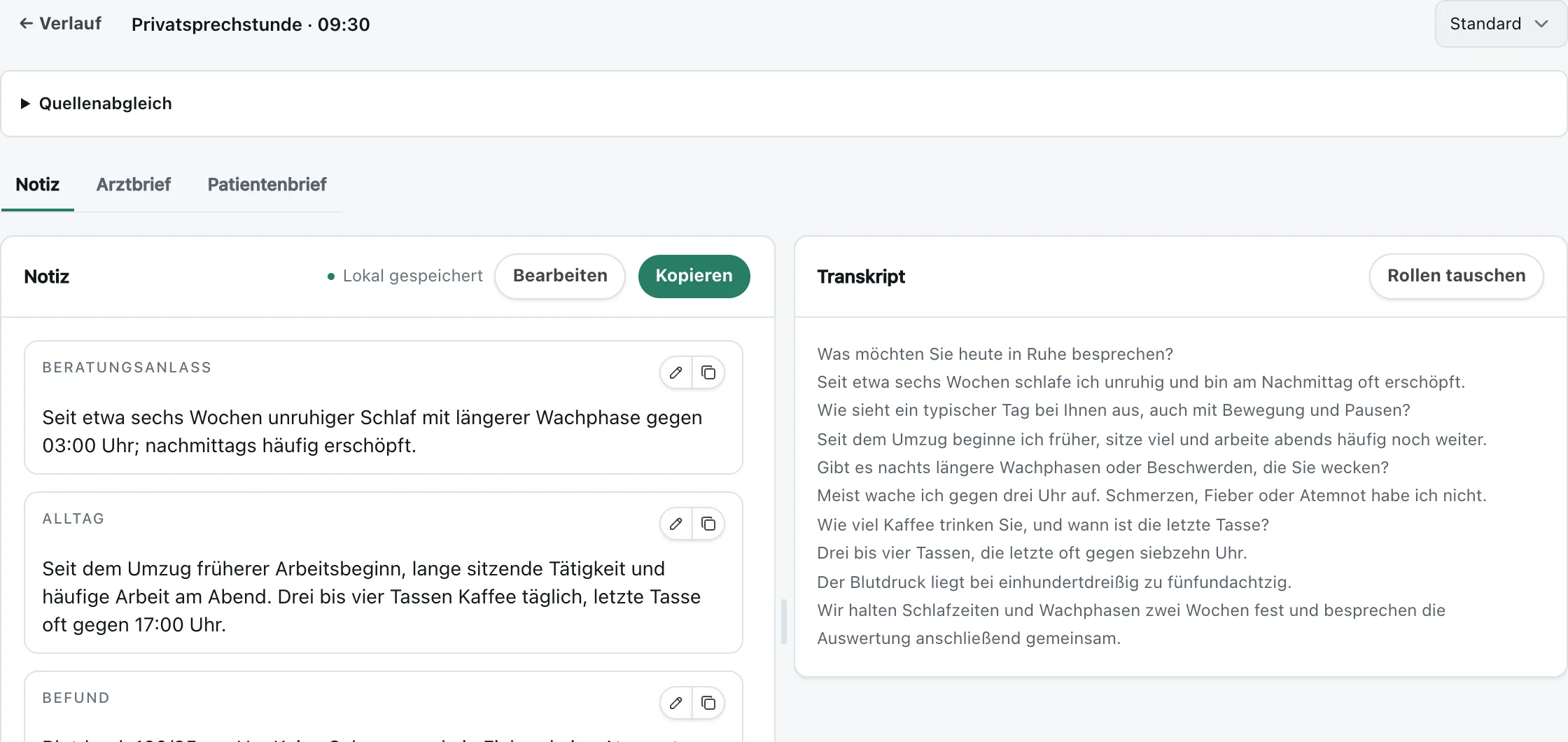

Real application screens, not redrawn. The consultation shown is entirely fictional.
What you get
Six things that decide whether a draft helps at the end of the day or adds to it.
You stay in the conversation
You never have to think about the technology. One appointment stays one appointment, however many segments it has — pause, resume and a disconnected microphone all run through the same path without you stepping in.
The recording stays with you
One question fewer for your data-protection adviser: recognition runs entirely on your practice computer, so there is no audio transmission for you to assess or explain. Consultations in German or English; the draft is always German.
Who said what is right there
You correct less, because the draft already says who said what: the history holds what the patient reported, the assessment holds your own words. Swapped? One click. And if attribution fails once, the draft is still produced, from the transcript without speaker labels.
Your templates, your style, in black and white
Note templates are plain text you edit yourself. KiPT Voice measures, section by section, how much of the draft you still correct. So you can see whether an edited template really moved closer to how you write.
Consent first. Always.
Recording begins only once everyone present has agreed: the first step of every session, with a timestamp (§ 201 StGB, German criminal code), and a step you confirm rather than dismiss.
Your judgement stays yours. On purpose.
We structure what was said. KiPT Voice assigns no diagnoses, no differential diagnoses and no ICD codes. That is why it is not a medical device, and why your clinical assessment stays entirely with you.
Cloud tools upload the recording. KiPT Voice does not.
Many tools send the audio recording to a server for processing and delete it after transcription. With KiPT Voice that path does not exist.
| Processing outside the practice | KiPT Voice | |
|---|---|---|
| Audio recording | uploaded to a server and deleted after transcription | stays on your computer |
| Transcription | runs in the cloud | runs on your practice computer |
| Speaker attribution | runs in the cloud | also runs on your practice computer |
| What is transmitted | audio and text | only transcript text; nothing at all when the draft is created on the practice computer |
| Without an internet connection | depends on a connection for processing | recording and transcription carry on |
This compares two ways of handling audio, not individual products. A provider’s privacy policy should explain what happens to the recording.
Consult in English. Document in German.
KiPT Voice transcribes English-language consultations locally on your computer and turns them into a structured German documentation draft. You stay in your patient’s language during the conversation and no longer translate the documentation yourself afterwards.


Choose English before you start
You set the consultation language before recording. That is more reliable than any automatic detection.
Transcribe English locally
The audio recording stays on the practice computer. The English transcript is produced entirely there too.
Receive a German draft
The English transcript becomes a structured German draft for physician review in one step.
Because the draft is translated, its wording is not verbatim. You read, correct and approve it before transfer.
Four commitments you can verify
What stays on your computer and what is processed as text is stated here, in four sentences.
Audio stays on your computer
Recordings sit encrypted on disk and are deleted when the note is finished. They are never transmitted at any point. So there is no audio transmission for you to assess in the first place.
Only text leaves the computer
If an external service creates the draft, it receives transcript text and nothing else. When the draft is created on the practice computer, the text stays there too.
Retention is yours to set
Transcript and note are kept for 90 days by default, and you set the period. KiPT Voice never asks for a patient name; what a session is called is up to you.
Technical reporting can be disabled
Technical performance and error reporting can be disabled in settings. When error reporting is configured, Sentry (EU) receives only fixed failure codes and technical measurements, never audio, transcript or note content.
Try it for 14 days first. Then choose.
Both plans are per physician and include the full application, every update, email support and the privacy package. All prices plus VAT.
14 days free · no credit card · ends by itself
Included in both plans
- The application for Windows 11 and Mac with an Apple chip
- Every update during the term
- Support by email
- The privacy package with six templates for your practice's advisers
You choose the number of physicians at checkout and can change it at any time. After the trial you actively choose a plan. Do nothing and the trial simply ends; nothing is charged.
Frequently asked
Does this work with my practice software?
Yes, with any of them. You copy the reviewed draft into your existing practice software. No vendor-specific integration is needed for that.
Do I need an internet connection?
Not for recording or transcription; both run on your practice computer. If the connection drops during a consultation, nothing is lost; only the draft is created later. If an external service is used for that, it receives transcript text and nothing else. When the draft is created on the practice computer, KiPT Voice works entirely offline.
Which machines are supported?
Windows 11 and Macs with an Apple chip. Transcription begins as soon as you pause a segment or end the session.
What happens if the application crashes?
You lose at most the segment in progress, never the appointment. KiPT Voice writes the session state to disk on every step, finds the interrupted session on next start and continues processing.
How large is the installation?
On first launch, KiPT Voice downloads the required language files once in the background. They then remain available for recording and transcription without an internet connection.
Is this a medical device?
KiPT Voice documents what was said; the clinical assessment stays with you. It makes no diagnoses, suggests no differential diagnoses and assigns no ICD codes. That is why it falls outside the scope of the EU Medical Device Regulation.
What about § 203 StGB and medical confidentiality?
We have prepared for it. KiPT Voice comes with a data processing agreement, a confidentiality undertaking along the processing chain and an Art. 13 GDPR patient notice. Your legal counsel reviews, you decide.
Which languages are supported?
Consultations in German and English. The draft is always produced in German, because the patient record is German. The interface switches between German and English.
Ready in four steps
From the first email to the first recording, the application walks you through it. The first 14 days cost nothing.
Request the installer
Three sentences by email: your specialty, Windows 11 or Mac with an Apple chip, how long your consultations run. Installer and activation arrive within one business day.
Download once
On first start, KiPT Voice downloads what it needs for transcription to your computer, once. From then on transcription runs there, with no outside connection.
Choose the microphone
In settings you pick the microphone KiPT Voice records with.
Pass the system check
A check inside the application shows whether anything is missing before you record the first consultation.
We reply personally by email. Activation and subscription happen only on your explicit decision.
Your next consultation: listen instead of typing.
For practices in Germany with long consultations. Three sentences by email are enough: specialty, operating system, how long your consultations run. Installer and activation arrive within one business day.
Or write directly to
Do not send patient information. A personal response, no newsletter, no sales call.